
It’s been a little more than a week since Takeoff was shot and killed in Houston. He is another in a long line of great rappers that have died in the last 5 years. In just the hip-hop community, we’ve lost Nipsey Hussle, Pop Smoke, XXXTentacion, Juice WRLD, and too many others. We lost PnB Rock just about a month before Takeoff. This isn’t something only the newest hip-hop generation is facing. Two of the GOATs were victims of gun violence in the 90s, Tupac and Biggie. The problem is complex, and there isn’t one solution. It isn’t just gang violence. There are more significant systemic issues that play a role in this. We must start holding ourselves and the music industry accountable. We are hearing the music, but we are not listening to what is being said. The recording companies sign these people off the streets just to make millions of dollars off them, then just move on when they are killed.
First off, I want to set the record straight. It has nothing to do with the music. Hip-hop is not causing violence; hip-hop portrays the worlds they come from. They aren’t rapping about murder because that’s what they want but because it’s what they know. They come from the streets; they grow up in this violence. The music is a result of the problem, not the cause. Art can very commonly be a way to express specific life experiences. On “Rain,” YoungBoy raps about wanting to “get up off the streets.” And in the second verse of the song, he raps, “I told ’em all about my pain, been maneuverin’ through the game, But after all, they still down us and drag us.” And YB is not the only one. “The Heart Part 5,” Kendrick’s single for “Mr. Morale and the Big Steppers,” uses sarcasm to tell you it’s not the culture causing the violence. He looks at the “cycle of grief” that is a part of the black experience in America. You need to check out Complex’s analysis of “The Heart Part 5.” Anyway, “hurt people hurt people.”
These issues aren’t just prevalent in hip-hop but in America as a whole. Gun violence has defined our generation between mass shootings and lack of gun regulation laws. How many times do we need to experience loss of life through guns before we put our foot down and say enough is enough? If it is a cultural problem, it is American culture, not hip-hop culture. It is simply too easy to obtain a gun, whether that be legally or illegally. God knows the number of shootings that have happened in the last year in the US. It is not something that is just in hip-hop; it is everywhere. The simplest thing we can do is fight for stricter gun laws. However, gun laws won’t be enough to stop it.
That is why we need some accountability from the recording industry. For example, the label ‘Empire’ has lost 7 rappers in the last 5 years alone. How does a major label like that keep letting its artists down? There has to be a change in how record labels conduct business. Most rappers and hip-hop artists are “discovered.” Especially today, with sites like SoundCloud, that fame can be instantaneous. And when they do come from gang backgrounds, that notoriety can be a way to target them. PnB Rock’s girlfriend posted their location on Instagram, and that’s how his shooters got to him. The music industry takes more responsibility for protecting its artists. Calvin Smiley, a hip-hop expert at Hunter College, told the Guardian, ““They know that when they’re done, the next SoundCloud or Instagram rapper is behind them.”
It’s not just gun violence, either. The media and the recording industry largely ignore the mental health of hip-hop artists. Mac Miller grew up in a high-income neighborhood in Pittsburgh. He came from a relatively “normal” life, whatever that means. He was openly honest about how the celebrity lifestyle negatively affected his anxiety and depression. He was also open about his own battle with drug addiction. He talked about it in interviews and songs for years. And everyone knew where his mental health was in the months before his death, after the breakup with Ariana Grande and her quick engagement to Pete Davidson. He basically foreshadowed his own death. “So It Goes” is the last song on the last album Mac released before his death. “So It Goes” was the famous line from Kurt Vonnegut’s ‘Slaughterhouse-Five.’ That line is used every time someone dies. Using that with Mac’s since-deleted tweet below, Mac was screaming out for help. The ending of the song was also the last Insta story he posted. Mac ultimately joined the “27 club” in 2018.
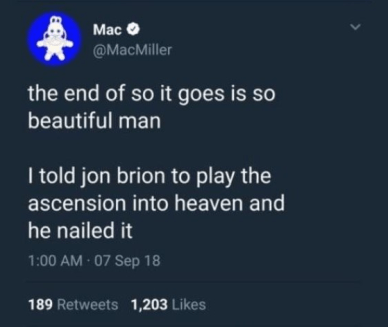
It all comes down to one thing. We must better understand and support the hip-hop artists we listen to. Everyone is quick to blame the culture, but nobody wants to talk about the systemic issues that have led to the current state of hip-hop. The recording industry needs to do a better job of being there for the artists they sign; their talents are not to be exploited for profit. They need to treat the artists as real people, not just as products. We are losing too many talented, young artists. We need to do better as a population. There are larger issues within the US, like gun violence, mental health awareness, and substance abuse need to be addressed. There is more we can and need to do!


 Jakey's Takeys
Leave a comment